
The most common pressure washer mistake in commercial and industrial facilities is buying based on PSI without thinking about temperature. Pressure removes surface debris. Heat breaks down grease, oil, and biological contamination. If your facility is dealing with grease and you buy a cold water unit, you will spend significantly more time, chemical, and effort trying to compensate for the missing heat.
The right choice between a hot water and cold water pressure washer depends almost entirely on what you are cleaning and what the contamination is made of.
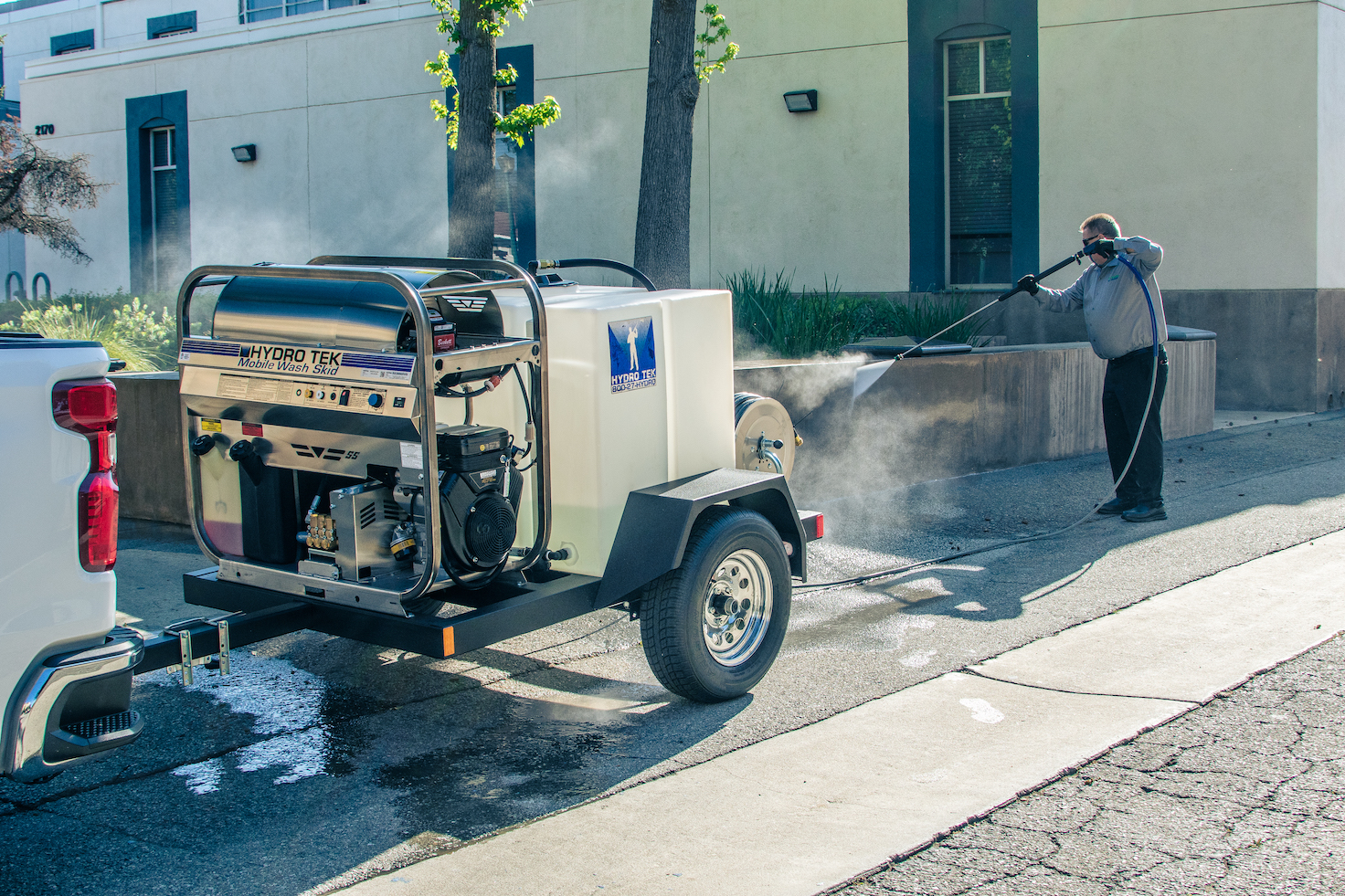
HydroTek Pressure Washer
How Cold Water Pressure Washers Work
Cold water pressure washers deliver high-pressure water at ambient temperature. They are effective at removing dirt, mud, dust, loose debris, and surface contamination that breaks free under pressure without requiring heat to release it.
Cold water units are simpler, lighter, and lower cost than hot water systems. They do not have a burner, fuel system, or heat exchanger to maintain. For applications where heat is not necessary — washing down concrete surfaces with surface dirt, cleaning equipment exteriors between tasks, rinsing loading docks and staging areas — cold water pressure washers deliver results efficiently.
The limitation is grease and oil. Cold water pressure against a greasy surface pushes the grease around rather than emulsifying and lifting it. You can compensate with aggressive degreasers and extended dwell time, but you are working against the physics of the problem rather than with them.
How Hot Water Pressure Washers Work
Hot water pressure washers add a burner and heat exchanger to the pressure system, heating the water to temperatures typically in the 180 to 200 degree Fahrenheit range. That heat fundamentally changes what the water can do to grease and oil contamination.
Hot water emulsifies grease the same way dish soap and hot water clean a greasy pan — except at industrial pressure and scale. Grease releases from the surface, emulsifies in the hot water stream, and washes away. The combination of heat, pressure, and detergent (when used) addresses contamination that cold water simply cannot break down efficiently.
Hot water systems cost more and have more components to maintain — the burner, fuel supply, and heat exchanger add operational complexity. But for facilities where grease and oil contamination is part of the regular cleaning challenge, the productivity difference more than justifies the additional investment.
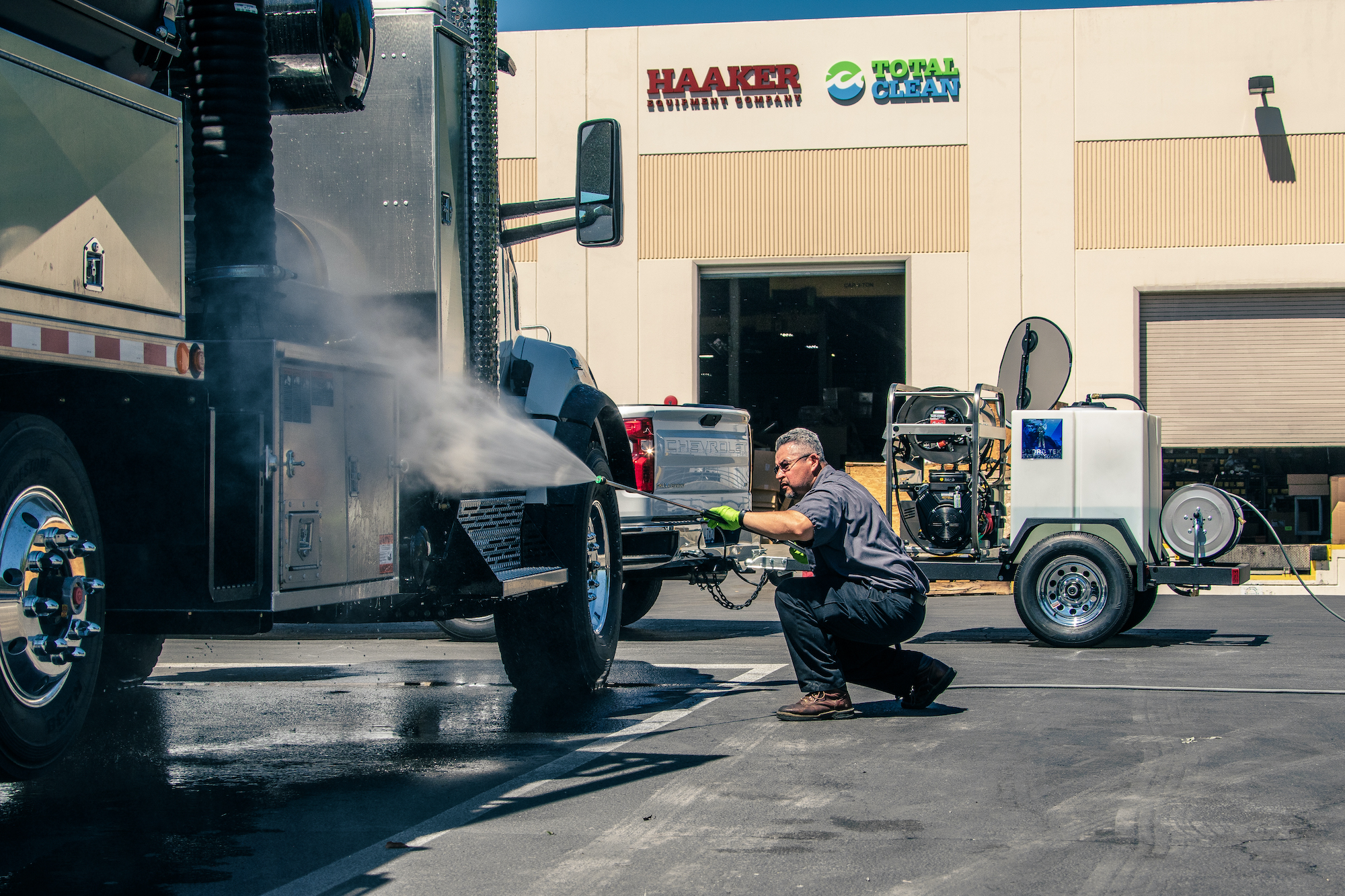
Application Guide: Which System Fits Your Facility
Food processing and packing plants: Hot water is the standard. Organic contamination — fats, oils, food residue, and biological material — requires heat for effective breakdown. Central Valley food processing operations in Fresno, Visalia, Tulare, and Bakersfield running USDA or state food safety compliance programs need hot water systems to meet sanitation standards.
Fleet washing and vehicle maintenance: Hot water is strongly preferred for engine bays, undercarriages, and any surface with accumulated grease and road oil. Cold water washes the exterior sheet metal fine. Hot water is what cleans a diesel engine bay or a hydraulic system maintenance area effectively.
Concrete and masonry surface cleaning: Cold water is often sufficient for concrete driveways, exterior walls, and parking structures where the soil is surface dirt and atmospheric contamination rather than grease. If grease is present on the concrete — from vehicle drips, industrial spills, or kitchen exhaust runoff — hot water is more effective.
Manufacturing and industrial equipment: Depends on the process. Metal machining operations with cutting oil contamination need hot water. Assembly operations with dry dust and particulate contamination may be well served by cold water.
Loading docks and warehouse floors: Loading docks accumulate both surface debris and grease from equipment and vehicles. Hot water addresses both categories in a single pass. Warehouse interior floors with minimal grease contamination can be served by cold water, though many facilities prefer hot water systems for the sanitation confidence they provide.
Exterior building washing and retail property maintenance: Cold water pressure washing is the standard for commercial building exteriors, storefront glass surrounds, and parking lot surfaces without grease contamination. Hot water adds cost without proportional benefit for these applications.
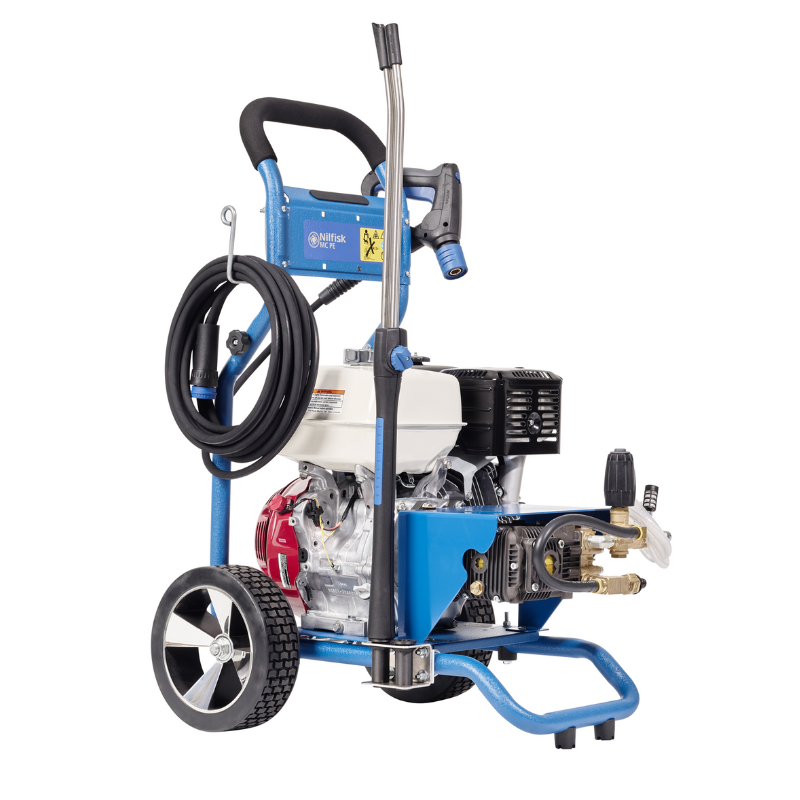
Key Specs to Understand
PSI (pounds per square inch): Measures water pressure. Higher PSI increases the mechanical force against the surface. Commercial and industrial applications typically run 2,000 to 4,000 PSI. More is not always better — excessive PSI on delicate surfaces causes damage.
GPM (gallons per minute): Measures flow rate. Higher GPM moves more water through the system per minute, which affects how quickly contamination is rinsed away. PSI and GPM together determine cleaning units (CU = PSI x GPM), a useful combined measure of cleaning power.
Temperature range (hot water units): Look for units that reach 180 to 200 degrees Fahrenheit at the nozzle for effective grease emulsification. Units that claim hot water but deliver temperatures below 140 degrees are not providing the heat needed for grease breakdown.
Fuel source (hot water units): Diesel-fired burners are standard for industrial trailer-mounted and skid-mounted systems. Electric heating elements are available for indoor applications where open flame or exhaust is a concern.
HydroTek: Total Clean Equipment’s Pressure Washer Line
Total Clean Equipment carries HydroTek pressure washing systems — commercial and industrial grade hot water and cold water units available in a range of PSI, GPM, and configuration options. HydroTek builds trailer-mounted, skid-mounted, and wall-mounted systems for facilities with fixed wash stations and mobile cleaning programs.
Our team can specify the right system for your application, floor surface, contamination type, and production requirements from any of our California, Nevada, or Arizona branch locations.
Talk to the Haaker Total Clean Team
Haaker Total Clean serves facilities across California, Nevada, and Arizona from branches in La Verne, Colton, Santee (San Diego area), Tulare, Hayward, Las Vegas, and Phoenix. Whether you need a hot water system for a food processing operation in Fresno, a fleet wash setup in the Inland Empire, or a cold water unit for a commercial property in the Bay Area, our team can match the right equipment to your application.
Browse HydroTek Pressure Washers | Contact Our Team
Frequently Asked Questions
What is the difference between hot water and cold water pressure washers?
Cold water pressure washers deliver high-pressure water at ambient temperature and are effective for removing surface dirt, mud, and loose debris. Hot water pressure washers add a burner and heat exchanger to heat the water to 180 to 200 degrees Fahrenheit, which emulsifies and breaks down grease, oil, and biological contamination that cold water cannot remove efficiently. The choice depends on the type of contamination you are cleaning.
Do I need a hot water pressure washer for food processing?
Yes, in almost every case. Food processing and packing facilities deal with fats, oils, and biological contamination that require heat for effective breakdown and sanitation. Cold water pressure washing is not sufficient for food safety compliance in most USDA and state-regulated food processing environments. Hot water systems are the industry standard for food processing sanitation programs.
Is a hot water pressure washer worth the extra cost?
For grease and oil applications, yes. The productivity difference between a hot water and cold water system on a greasy surface is significant. Hot water emulsifies grease in seconds. Cold water requires more chemical, more dwell time, and multiple passes to achieve the same result. For facilities where grease is a regular cleaning challenge, the hot water premium pays back quickly in labor savings.
What PSI pressure washer do I need for industrial use?
Most commercial and industrial applications run between 2,000 and 4,000 PSI. Higher PSI increases the mechanical force against the surface, which helps with stubborn bonded contamination. However, PSI alone does not determine cleaning effectiveness — GPM (flow rate) and temperature (for hot water systems) are equally important. Total Clean Equipment can help you select the right combination of PSI, GPM, and temperature for your specific application.
Does Haaker Total Clean carry HydroTek pressure washers in California?
Yes. Haaker Total Clean is an authorized HydroTek dealer serving California, Nevada, and Arizona. We carry hot water and cold water pressure washing systems in trailer-mounted, skid-mounted, and wall-mounted configurations. Contact your nearest branch in La Verne, Colton, Tulare, Hayward, or Santee to discuss your application requirements.
Haaker Total Clean has served commercial and industrial facilities across California, Nevada, and Arizona for over four decades. Nobody works harder for you.